Thank you for sending your enquiry! One of our team members will contact you shortly.
Thank you for sending your booking! One of our team members will contact you shortly.
Duration 4 hours
Course Outline
The Design Thinking Mindset & Innovation Landscape
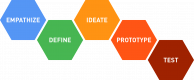
- The 5 Stages: A detailed exploration of Empathize, Define, Ideate, Prototype, and Test.
- Innovation Theory: Gaining insight into the relationship between DT, disruptive innovation, and entrepreneurship.
- The Problem Space: Learning to identify patterns and problem definitions, recognizing why pinpointing the right problem is more critical than finding a solution.
- Group Exercise: Distinguishing between "Why" and "How" to identify a real-world complex problem to address throughout the day.
Empathy, User Research & Problem Definition
- Empathy Mapping: Utilizing techniques to comprehend user pain points, needs, and motivations.
- Stakeholder Mapping: Identifying affected parties and strategies for engagement.
- The Persona: Developing archetypes representing the target audience.
- Defining the Problem: Crafting effective Problem Statements (Point-of-View statements) and "How Might We" (HMW) questions to frame the challenge.
- Workshop: Drafting personas and problem statements for the group's selected case study.
Ideation & Divergent Thinking
- Generating Ideas: Applying techniques to overcome creative blocks, such as SCAMPER, Brainstorming rules, and the Worst Possible Idea method.
- Idea Selection: Using methods to filter and prioritize ideas, including Dot voting and the Impact/Effort Matrix.
- Agile Estimation: Introducing basic techniques to assess the viability of generated ideas.
- Group Exercise: Conducting a rapid ideation sprint to generate solutions for the defined problem.
Prototyping & The Art of Failing Fast
- Prototyping: Applying principles of rapid prototyping, such as using paper, cardboard, storyboarding, and role-play.
- Testing: Learning to formulate a test plan and collect meaningful feedback.
- Iterative Approach: Embracing the "Build-Measure-Learn" cycle and viewing failure as a valuable learning tool.
- Tools: Introduction to Customer Journey Maps and Service Blueprints for visualizing solutions.
- Workshop: Creating low-fidelity prototypes of the top solutions.
Testing, Evaluation & Refinement
- Running the Test: Presenting prototypes and asking the right questions to elicit useful insights.
- Feedback Loops: Differentiating between constructive feedback and personal preferences.
- Model Drift: Recognizing when a solution begins to deviate from the user's core needs.
- Group Exercise: Peer testing of prototypes and refining the solution based on received feedback.
Scaling Impact & Leadership Readiness
- Business Model Innovation: Aligning the solution with the Business Model Canvas.
- Critical Thinking & Leadership: Integrating the DT mindset into daily work practices and decision-making processes.
- Cultural Implementation: Overcoming resistance to change and fostering a culture of psychological safety.
- Final Reflection: Summarizing key takeaways, developing personal action plans, and closing the loop on the learning journey.
Requirements
Who Should Attend
- Professionals aiming to strengthen their creative problem-solving and innovation capabilities.
- Leaders seeking to cultivate a culture of empathy and forward-thinking within their teams.
- Individuals interested in disruptive innovation, product design, or process optimization.